Build Scenes Using HERE HD Live Map Data
R2026bThis example shows how to build scenes in RoadRunner by using HERE HD Live Map1 data, for an area in Santa Clara, California that contains overpasses, barriers, and signs. This example requires a RoadRunner Scene Builder license.
Note
HERE HD Live Map provides data in two formats, a native format based on protocol buffers and the industry-standard Navigation Data Standard (NDS) format. RoadRunner only supports the import and build of HERE HD Live Map data in classic native protocol buffer-based format.
Prerequisites
You must have a HERE Marketplace account. For information on creating one, see Get a HERE account.
Your HERE Marketplace account must contain a project that includes the required catalogs for the region in which you want to build your scene. Catalogs store map data for specific geographic regions. Currently the HERE HD Live Map service provides catalogs for regions in North America and Western Europe. RoadRunner currently supports catalogs with these HERE Resource Name (HRN):
North America —
hrn:here:data::olp-here-had:here-hdlm-protobuf-na-2Western Europe —
hrn:here:data::olp-here-had:here-hdlm-protobuf-weu-2
For more information on creating a project and linking catalogs, see Manage HERE Projects.
You must register an app to your HERE account, specifying the project that contains your required catalogs as the default project. For more information, see Manage HERE Apps.
Generate Access Key ID and Access Key Secret credentials for the registered app. These credentials enable you to connect RoadRunner to your HERE HD Live Map project. For more information on how to create these credentials, see Get App Credentials.
Choose Area of Interest
Open the World Settings Tool from the toolbar by clicking the World Settings Tool button. Specify the area of interest by using the World Settings Tool.

In the Attributes pane, in the World Origin
section, specify the Latitude as 37.4156 degrees
and the Longitude as -121.9749 degrees. In the
Workspace section, under Extents, specify
both X and Y as 750 meters.
Apply your changes by selecting Apply World Changes.
Note
The Latitude and Longitude coordinates must point to an area within the regions included in the catalogs linked to your HERE project.
Import and Explore Data
Open the Scene Builder Tool from the toolbar by clicking the Scene Builder Tool button.

Import HERE HD Live Map Data
Then, import the HERE HD Live Map data by clicking the Import Data For Area button on the toolbar to the left of the scene editing canvas.

This opens a HERE HD Import Settings dialog box. On the HERE HD Live Map Marketplace Credentials tab of this dialog box, you must enter valid HERE HD Live Map access credentials, Access Key ID and Access Key Secret.
On the Settings tab specify the Select Asset Mapping File from these options:
HEREAssetData_NA.xml— Asset mapping file for North America region.HEREAssetData_WE.xml— Asset mapping file for Western Europe region.
Once you have specified your access credentials and the desired asset mapping file, click OK. RoadRunner saves these credentials for the rest of this RoadRunner session on your machine. To save these credentials for future RoadRunner sessions on your machine, select Save my credentials. The credentials remain saved until you delete them.
You can delete the existing credentials by erasing them from the HERE HD Live Map Marketplace Credentials tab of the dialog box and clicking OK. RoadRunner displays an error message indicating an issue with either your credentials or your connection to the download server. Ignore the error message, and select Cancel to close the dialog box.
Import Data from HERE Protobuf Files
To import data from a directory containing HERE protobuf files, select Open HD Map Root Folder from the toolbar to the left of the scene editing canvas.

This opens an Import HD Data folder dialog box to specify the type
and source of the HD Map data. Set the Source Type parameter to
HERE, and specify the Select Asset Mapping
File from these options:
HEREAssetData_NA.xml— Asset mapping file for North America region.HEREAssetData_WE.xml— Asset mapping file for Western Europe region.
Set the Protobuf Folder's Root Folder by navigating to the
directory that contains your HERE protobuf files. By default, RoadRunner Scene Builder unpacks the .gz file containing HERE protobuf files
and imports the data. To skip this step, clear the Uncompress using
gzip parameter.
RoadRunner saves the specified Import HD Data folder dialog box parameters for future RoadRunner sessions on your machine.
Visualize Imported Data
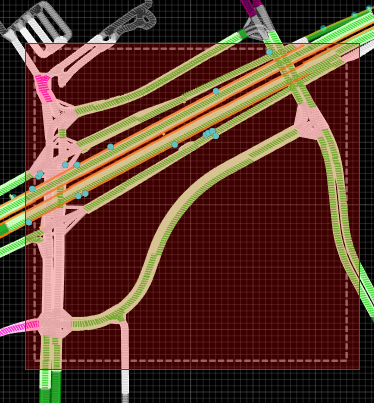
The Scene Builder Tool imports HERE HD Live Map data from HERE tiles that intersect your workspace, converts the data into a preview called a RoadRunner HD Map, and displays the RoadRunner HD Map in the scene editing canvas. For more information on RoadRunner HD Map data, see RoadRunner HD Map Data.
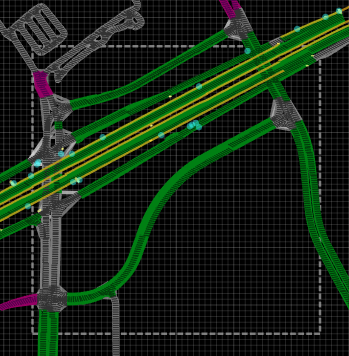
Explore the imported data by selecting control points, lane boundaries, lanes, lane groups, and scene objects. You can view their properties on the Attributes pane. The type of road element selected in the HD Map scene editing canvas determines the available properties.
Scene Builder
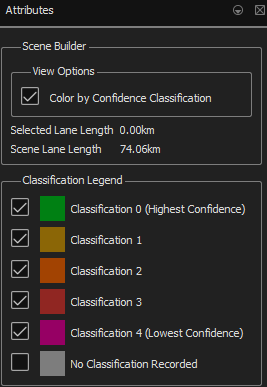
Color by Confidence Classification — By default, the RoadRunner HD Map displays the confidence classifications of the imported data using the colors shown in the Classification Legend attribute. For more information about classification, contact HERE Technologies.
To remove both the Classification Legend from the Attributes pane and the color classification from the RoadRunner HD Map preview, clear this option.
Selected Lane Length — Length of the selected lanes.
Scene Lane Length — Length of the total lanes in the scene.
Classification Legend — Color codes for the confidence levels of roads imported from the HD map data. For more information about classification, contact HERE Technologies.
By default, RoadRunner displays the roads for all confidence classification levels. To remove roads for a specific classification level from the scene editing canvas, clear the corresponding check box. For example, to remove all roads for which classification has not been recorded, clear the check box next to the gray square for No Classification Recorded, as shown in this figure.
Lane
Id — Unique identification number for the selected lane.
Speed Limit — Maximum allowed driving speed of the lane.
Lane Type — Type of the lane, specified as driving or shoulder.
Travel Direction — Direction of travel for the road segment, specified as forward, backward, or bidirectional.
Start Lanes — Displays the list of lanes, and their IDs, connected to the start of the selected lane.
End Lanes — Displays the list of lanes, and their IDs, connected to the end of the selected lane.
You can view unique IDs for the Lane Boundary and confidence classifications for the Lane Group on the Attributes pane.
Barrier
Id — Unique identification number for the selected barrier.
Flipped — Select this field to flip the orientation of barrier along the lateral direction. Use this field to flip the primary face of the extrusion geometry.
Extrusion Asset — Displays the extrusion asset image available in the asset library which is relevant to the imported scene object.
Pole
Id — Unique identification number for the selected scene object.
Prop Asset — Displays the asset image available in the asset library which is relevant to the imported scene object.
Sign
Id — Unique identification number for the selected scene object.
Prop Asset — Displays the asset image available in the asset library which is relevant to the imported scene object.
For the imported objects, you can also view object specific metadata in the Metadata pane. You can locate the Metadata pane next to the Attributes pane to the right of the scene editing canvas.
| Object | Metadata |
|---|---|
| Sign | Sign Type, Sign Value, Sign Shape, and Sign Color. |
| Pole | Pole Type and Pole Diameter |
| Barrier | Barrier Type |
Note
If you delete or modify metadata for the imported Sign, Pole, or Barrier objects, that information is excluded or updated when you export to other file formats.
Build Scene
Click the Build Scene button on the toolbar to the left of the scene editing canvas.

Building scenes using the Scene Builder Tool requires a RoadRunner Scene Builder license.
In the Scene Builder dialog box, you can view and modify these options:
Fit Cross Sections — By default, the Scene Builder Tool imports cross-section information such as superelevation (banking) and crowning. To import flat cross-sections, clear this option. For more information about cross-sections, see the Cross Section Tool.
Auto Detect Asphalt Surfaces — By default, the Scene Builder Tool detects asphalt surfaces and applies an asphalt texture to them. To apply a grass texture to all surfaces, clear this option. For more information about surfaces and textures, see How Surfaces Work in RoadRunner.
Clear Scene of Existing Data — By default, the Scene Builder Tool removes already built roads from your scene when you use it to build a scene. To keep the existing roads in the scene, clear this option.
Auto Correct Unrealistic Road Elevation — By default, the Scene Builder Tool attempts to automatically correct unrealistic elevations of imported roads. The tool bases elevation corrections on the elevation data of neighboring roads that have been imported with high confidence from the HERE HD Live Map data. To manually correct unrealistic road elevation for the imported HERE HD Live Map data, clear this option.
Remove Inconsistent Lane Connections— By default, the Scene Builder Tool retains all lane connections, including those that may be physically unrealistic. When you select this option, the tool programmatically analyzes the lane connectivity within your road network and removes lane connections that cannot exist realistically. This option prevents the creation of unusable and convoluted road layouts, that result from manual scene editing or importing data from sources such as HERE HD Live Map data, OpenStreetMap® (OSM), or Tom Tom HD Map data. To retain all imported or manually created lane connections, clear this option.
Combine Transition Lanes — By default, the Scene Builder Tool combines the transition lanes in the imported HD map to build a single road. Transition lanes are multiple lanes derived from a single road, used to guide vehicle movement from one lane to another in response to changes in road conditions. For example, this figure shows transitions lanes branching from a single road in a RoadRunner HD Map.
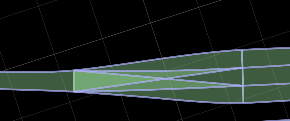
Select Combine Transition Lanes to reduce the creation of overlapping roads and the number of junctions in the built scene. Clear this option to retain the connectivity information among adjacent transition lanes in the built scene.
Use Lane Groups — By default, the Scene Builder Tool uses lane groups to build roads. When you use lane groups, the tool builds a distinct road by combining only those lanes that are part of the same lane group. The tool uses the geometry of lane groups to produce road curves. If the geometry of a lane group is not available, then the tool uses the geometry of the lane boundaries of that lane group to produce the corresponding road curve.
Clear this option to ignore the lane group data, which enables the tool to combine more lanes together to build a road. The tool combines all the lanes, between junctions, into a single road. This enables you to build a smaller number of longer roads than you can build by using lane groups. When you ignore lane groups, the tool does not use the geometry of lane groups to produce road curves. Instead, the tool uses the geometry of lane boundaries to produce road curves.
Curvature Blend — The Scene Builder Tool builds roads using straight lines and circular arcs. Curvature Blend determines the portion of the arcs used for transitioning from a line to an arc. You can specify this value within the range [0, 1] to control the smoothness of the roads built along the curvature.
Enable Overlap Groups — By default, the Scene Builder Tool does not create automatic junctions at road overlaps. To create junctions, the tool uses explicit junction information specified in the imported HD map data. To create automatic junctions at geometric overlaps, clear this option. For more information on overlap groups, see Prevent Creation of Automatic Junctions Between Roads.
Overlap Group Name — When you select the Enable Overlap Groups option, the tool sets the Overlap Group Name option to
SceneBuild, by default. You can use the Overlap Group Name option to control the behavior of automatic junction creation when you build an HD map data over an existing scene. For example, if roads in the existing scene have an Overlap Group option value ofTransferImport, and you do not want to create automatic junctions at geometric overlaps between them and roads specified by HD map data, you must set the Overlap Group Name option toTransferImport. Otherwise the tool creates automatic junctions at geometric overlaps between the roads of the existing scene and the roads specified by the imported HD map data. To use this option you must select the Enable Overlap Groups option.Preserve Junction Lanes — Use the Preserve Junction Lanes option to preserve all junction lanes present in the imported map. When you select this option, the tool does not consider road overlaps in the map and instead uses the junction definitions from the imported map while building the RoadRunner scene. The tool builds junctions in the RoadRunner scene that retain the original junction lanes from the imported map. Selecting this option can prevent the tool from creating multiple broken junctions in the built scene. To use this option, you must select the Enable Overlap Groups option.
Effect of Preserve Junction Lanes Option on Junction Creation
RRHD Map with Junction Imported in RoadRunner Canvas Using Scene Builder Tool RoadRunner Scene Built Using Scene Builder Tool Without Preserve Junction Lanes RoadRunner Scene Built Using Scene Builder Tool with Preserve Junction Lanes 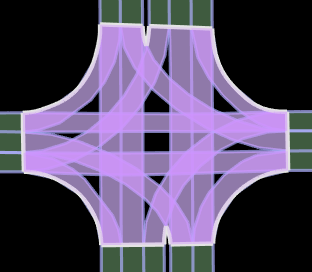
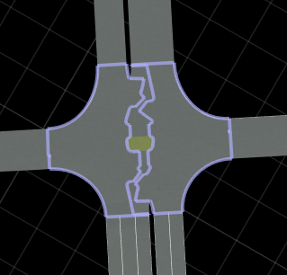
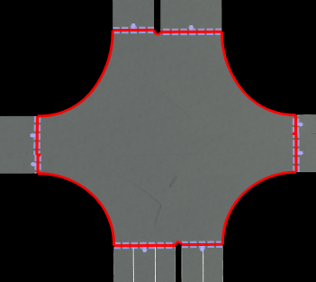
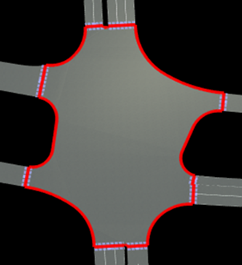
Preserve Junction Shape — Use the Preserve Junction Shape option to preserve the shapes of junctions present in the imported map. When you select this option, the tool builds the RoadRunner scene while using the junction polygon definitions from the imported map to preserve the original junction geometry in the built scene. If a junction definition does not include polygons, the tool does not preserve the junction shape. Additionally, if a junction polygon definition is complex and unrealistic, or if a junction polygon extends beyond junction lanes, the tool might not preserve the exact junction shape. To use this option, you must select the Enable Overlap Groups and Preserve Junction Lanes options.
Effect of Preserve Junction Shape Option on Junction Creation
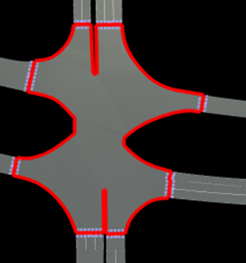
RRHD Map with Junction Imported in RoadRunner Canvas Using Scene Builder Tool RoadRunner Scene Built Using Scene Builder Tool Without Preserve Junction Shape RoadRunner Scene Built Using Scene Builder Tool with Preserve Junction Shape 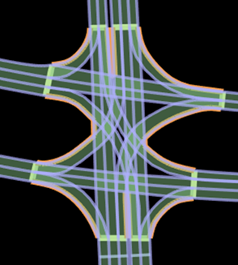
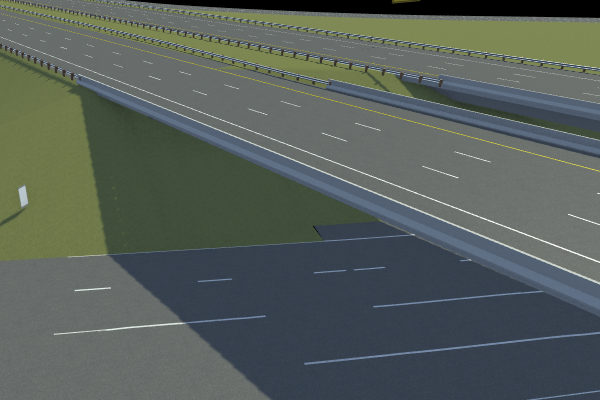
Auto Detect Bridges — By default, the Scene Builder Tool creates bridges at road intersections when the roads have different elevations. The tool extends the bridges by 20 meters on either side of the intersection. You can change the amount of extension by changing the Bridge Span Inflation value. To prevent the tool from creating bridges, clear this option. For more information, see Road Construction Tool.
Build Info — Displays the link length and number of links in all imported data, as well as in the selected subset of roads in the scene.
You can specify what to build from the imported data, in the Scene Builder dialog box, from these options:
All Data— Build all the imported data.Selected Data and Selected Routes— Build selected data and selected routes.To select scene objects, click each desired object. You can also click and drag in the scene editing canvas to draw a box around the objects you want to select.
Drag the box toward the top-left of the canvas to select only objects that are fully contained in the box.
Drag the box in any other direction (toward the bottom-left, top-right, or bottom-right) to select any object that is at least partially within the box.
The Scene Builder Tool retains previous selections, appending newly selected objects to the group of previously selected objects. To remove objects from the selection, hold Ctrl and either click the objects you want to remove or click and drag in the scene editing canvas to draw a box around them. To deselect all the currently selected objects, press Ctrl+D.
To start creating routes, right-click on the lanes in the scene editing canvas along the travel direction of the lane. For more information on creating routes, see Create Route and Build Scene Using HD Map Data.
You can also hold Shift and click additional routes to add them to the selection.
All Routes— Build all the roads and objects associated with the routes that you have created. For more information on creating routes, see Create Route and Build Scene Using HD Map Data.
You can also delete selected data to avoid building it.
For this example, build the entire scene by selecting All
Data and clicking Build.
Verify Results
The Scene Builder Tool builds the scene from the HERE HD Live Map data and displays information about the results in a dialog box. For information about troubleshooting common import issues, see Troubleshoot Import and Build Issues. To close the dialog box, select Close.
Navigate away from the RoadRunner HD Map by selecting a different tool. Then, explore the scene you built. For example, navigate to the intersecting roads and inspect the overpass.
Continue exploring and editing the scene by using other RoadRunner capabilities. Then, export the scene by selecting File, then Export and then selecting a supported file format. For more details, see Export Scenes.
Troubleshoot Import and Build Issues
If you encounter issues when the Scene Builder Tool imports data and builds scenes, try resolving them using the steps in this section. Some issues might be due to missing or inaccurate map data in the HERE HD Live Map service. Consider verifying the data by using an external map viewer.
Roads overlap at junctions
If the Scene Builder Tool detects physical anomalies when building roads, then RoadRunner might display this message in the Scene Builder Results dialog box:
>DEV: Detected potential accuracy issues in junction determined from
                    road overlap at this location
In other cases, you might notice unexpected shapes inside road junctions. To address these issues, navigate to the junction and edit it by using road tools such as the Road Plan Tool or Maneuver Tool.
Lane boundary issues
The Scene Builder Tool performs several checks for lane issues, including:
Lane boundaries that overlap themselves
Lane boundaries that have steep slopes
Left and right lane boundaries that cross each other
Lanes that do not connect to each other correctly at their geometric ends
To resolve these issues, use lane tools such as the Lane Add Tool or Lane Width Tool.
Road elevation issues
The Scene Builder Tool attempts to match the elevation of roads with the elevation of the imported data and performs checks for these road elevation issues:
Built roads have unrealistic elevation changes.
Built overpasses intersect with underlying roads.
To resolve these issues, you can adjust the road elevation manually by using the Road Height Tool. Alternatively, you can project roads to an elevation map by using the Project Roads operation in the Road Plan Tool. For more information about elevation maps, see Elevation Map Assets.
Bridges are not long enough
When the Scene Builder Tool creates a bridge from a road with multiple segments, the extension of the bridge on either side of the intersection might be shorter than the specified Bridge Span Inflation value. To address this issue, manually build a new bridge section by using the Road Construction Tool.
Surfaces are asphalt instead of grass
The Scene Builder Tool might apply asphalt materials to areas next to roads instead of grass materials. To drag a new material into the area, use the Surface Tool.
Props not aligned with ground surface
The Scene Builder Tool places imported props based on precise locations specified by the HERE HD Live Map service. These locations might not align with the ground and might appear to float. To resolve this issue, use the Surface Tool to modify the terrain so that props align with the ground.
Signs not attached to poles
The Scene Builder Tool might import signs, but not the poles that they are attached to. Create prop assemblies to attach the signs to by using the Prop Assembly Assets. To fill in signs, use the Sign Tool.
Assets not imported
The Scene Builder Tool uses an XML file that specifies what assets to use for rendering built scene data. If an asset does not import or is assigned to the wrong asset, you can modify this file to specify the correct asset types. For more details, see Configure Assets for Imported HERE HD Live Map Data.
See Also
Scene Builder Tool | Import | roadrunnerHDMap | importScene
Topics
- Configure Assets for Imported HERE HD Live Map Data
- Build Scenes Using TomTom HD Map Data
- Build Scenes Using Apollo HD Map Data
- Create Route and Build Scene Using HD Map Data
- Specify Route to Import HERE HD Live Map Data and Build Scenes
- gRPC API for Scenes and HD Maps
- MATLAB Functions for Scene Management
External Websites
1 You need to enter into a separate agreement with HERE in order to gain access to the HDLM services and to get the required credentials (access_key_id and access_key_secret) for using the HERE Service.

