matrixProfile
R2026bCompute matrix profile between all pairs of subsequences in a single-variable or multivariable time series
Since R2024b
Syntax
Description
A matrix profile is a distance-based method for detecting anomalous behavior by identifying subsequences in a time series that are either very similar or very different.
Similar subsequences, or motifs, often represent normal behavior
within the time series. Unique subsequences, or discords, indicate
possible anomalies. The algorithm compares all subsequences within the time series with every
other subsequence of the same length by calculating the z-normalized Euclidean distance for
each subsequence pair. The subsequence pairs with the minimum distance between them are known
as nearest neighbors. matrixProfile returns the
vector or matrix of these minimum distances, from smallest to largest, and of the
corresponding indices of the nearest neighbors within the profile.
Return Matrix Profile
MP = matrixProfile(X,len)X. The matrix profile is the vector of minimum
z-normalized Euclidean distances between each subsequence of X with
length len and its closest neighbor.
If
Xis a vector, then the software treats it as a single channel.If
Xis a matrix, then the software computes the matrix profile independently for each column (multivariable solution).
matrixProfile provides two different algorithms for performing
the computations.
The STAMP algorithm (scalable time series anytime matrix profile) supports anytime and parallel computation, and works with both single-variable and multivariable data sets. Anytime capability allows you to stop the algorithm before it completes and still obtain an acceptably accurate solution. This is especially useful when computing a complete solution requires a significant amount of time. The
MaxIterationname-value argument determines when to stop the computation.The STOMP algorithm (scalable time series ordered matrix profile) is approximately log2(n) times faster than the STAMP algorithm, and is useful for single-variable time series if you have a GPU and do not need anytime capability.
You can use the functions findDiscord and findMotif
to find the locations of the top discords and motifs in MP.
[___] = matrixProfile(___,
specifies options using one or more name-value arguments in addition to the arguments in
previous syntaxes. For example, to use parallel processing, set
Name=Value)UseParallel to true.
Plot Matrix Profile
matrixProfile(___) plots an interactive plot of the
matrix profile. You can use this syntax with any of the previous input-argument
combinations.
Examples
Load the data, which consists of T1. T1 is a timetable containing armature current measurements of a degrading DC motor.
load matrix_profile_data T1
Specify the time series variable X to T1.MotorCurrent and the query segment length to 100.
X = T1.MotorCurrent;
len = 100;
Calculate the matrix profile.
[MP,MPI] = matrixProfile(X,len);
Plot the matrix profile.
matrixProfile(X,len)
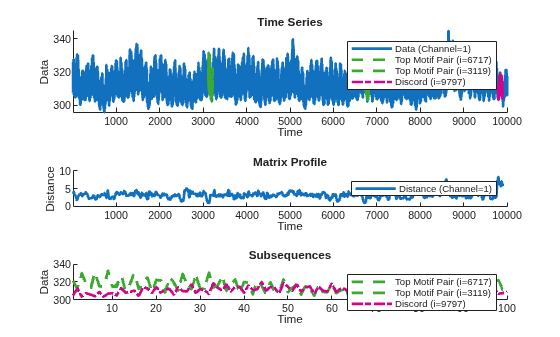
The profile shows the two top motif pairs, or segments that agree best with their neighbors, occur at locations 6717 and 3119. These locations are consistent with minima in the matrix profile plot.
The profile also shows a single discord at location 9797. This subsequence visibly deviates from the motif subsequences for much of its length.
Use findDiscord to find more discords, which are the locations of segments with the furthest distances from their neighbors. Show the top four locations.
locs = findDiscord(MP,MPI);
toplocs = locs(1:4)
toplocs = 4×1

        9797
        9800
        9802
        9792
Show the corresponding distances.
topdist = MP(toplocs)
topdist = 4×1

    8.3894
    8.2062
    8.1517
    7.9777
Plot the findDiscord results.
figure
findDiscord(MP,MPI)

Discords that are close to each other are probably part of the same anomaly. You need to identify only one discord for such a segment. Improve the segment separation and limit the number of discords to 10.
findDiscord(MP,MPI,MinSeparation=40,MaxNumDiscords=10)
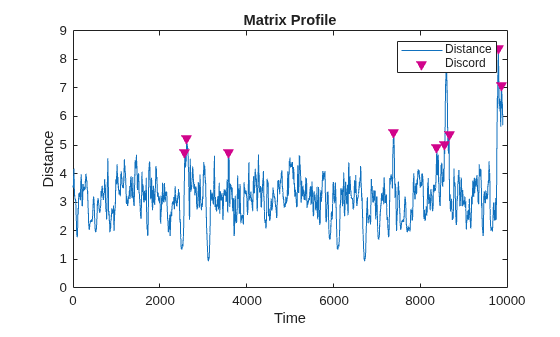
The highest discord is at location 9797, as the original matrix profile showed. The plot also shows significant discords in other locations.
Input Arguments
Name-Value Arguments
Output Arguments
References
[1] Yeh, Chin-Chia Michael, et al. “Matrix Profile I: All Pairs Similarity Joins for Time Series: A Unifying View That Includes Motifs, Discords and Shapelets.” 2016 IEEE 16th International Conference on Data Mining (ICDM), IEEE, 2016, pp. 1317–22. DOI.org (Crossref), https://doi.org/10.1109/ICDM.2016.0179.
[2] Zhu, Yan, et al. “Matrix Profile II: Exploiting a Novel Algorithm and GPUs to Break the One Hundred Million Barrier for Time Series Motifs and Joins.” 2016 IEEE 16th International Conference on Data Mining (ICDM), IEEE, 2016, pp. 739–48. DOI.org (Crossref), https://doi.org/10.1109/ICDM.2016.0085.

