Signal Propagation and Targets
R2026bA radar or sonar system simulation requires models for wave propagation, clutter and interference, array and target motion, and target cross-section. The Phased Array System Toolbox™ lets you model free-space signal propagation in monostatic or bistatic scenarios. Alternatively, you can employ simple multipath propagation using a two-ray propagation model. You can model atmospheric attenuation using line-of-sight (LOS) propagation models. These models calculate signal propagation through atmospheric gases, rain, and fog and clouds. All models include range-dependent time delay, phase shift, Doppler shift, and free-space loss. You can specify scattering radar cross sections (RCS) for nonpolarized radiation or scattering matrices for polarized radiation. The toolbox implements the four standard Swerling target radar cross-section models. The toolbox supports constant velocity and constant acceleration motion models.
The toolbox supports sonar system simulation by providing multipath propagation models, hydrophone and projector models, underwater noise sources and target strength models. Target strength models let you create nonfluctuating and Swerling fluctuating targets. The Underwater Acoustic Channels add-on lets you interface with the Bellhop beam-tracing model for underwater acoustic propagation.
The toolbox models target reflection and scattering by point-like reflectors. You can specify scattering radar cross sections (RCS) for non-polarized radiation or scattering matrices for polarized radiation. The four standard Swerling target scattering models are implemented. For the special case of backscattering radar scenarios, you can simulate an angle-dependent radar cross-section model. Radar cross-section models apply to both narrowband and wideband signals. You can also simulate the four standard Swerling backscattering models in sonar scenarios. For sonar system simulations, you can employ target strength models and create underwater noise sources.
Functions
Blocks
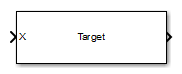 | Radar Target | Radar target |
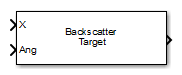 | Backscatter Radar Target | Backscatter radar target |
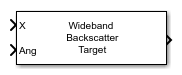 | Wideband Backscatter Radar Target | Backscatter wideband signals from radar target |
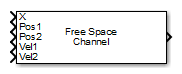 | Free Space | Free space environment |
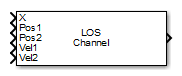 | LOS Channel | Narrowband line-of-sight propagation channel |
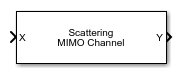 | Scattering MIMO Channel | Scattering MIMO propagation channel |
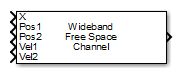 | Wideband Free Space | Wideband free space environment |
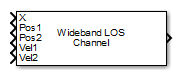 | Wideband LOS Channel | Wideband line-of-sight propagation channel |
 | Range Angle Calculator | Range and angle calculations |
 | Azimuth Broadside Converter | Convert azimuth angle to broadside angle or broadside angle to azimuth angle |
Topics
- Free Space Path Loss
Propagation environments have significant effects on the amplitude, phase, and shape of propagating space-time wavefields.
- Two-Ray Multipath Propagation
A two-ray propagation channel is the next step up in complexity from a free-space channel and is the simplest case of a multipath propagation environment.
- Radar Target
Model targets with fluctuating and nonfluctuating radar cross-sections.
- Get Started with Underwater Acoustic Channels
Get started with the Underwater Acoustic Channels add-on. (Since R2026b)

