multiplicationLayer
R2026bMultiplication layer
Description
A multiplication layer multiplies inputs from multiple neural network layers element-wise.
Specify the number of inputs to the layer when you create it. The inputs to the layer
have the names 'in1','in2',...,'inN', where N is
the number of inputs. Use the input names when connecting or disconnecting the layer by
using connectLayers or disconnectLayers, respectively. The size of the inputs to the
multiplication layer must be either same across all dimensions or same across at least
one dimension with other dimensions as singleton dimensions.
Creation
Properties
Examples
Create a multiplication layer with two inputs and the name 'mul_1'.
mul = multiplicationLayer(2,'Name','mul_1')
mul =
  MultiplicationLayer with properties:

          Name: 'mul_1'
     NumInputs: 2
    InputNames: {'in1'  'in2'}

   Learnable Parameters
    No properties.

   State Parameters
    No properties.

  Show all properties
Create two ReLU layers.
relu_1 = reluLayer('Name','relu_1');
relu_2 = reluLayer('Name','relu_2');
Create a dlnetwork object.
net = dlnetwork;
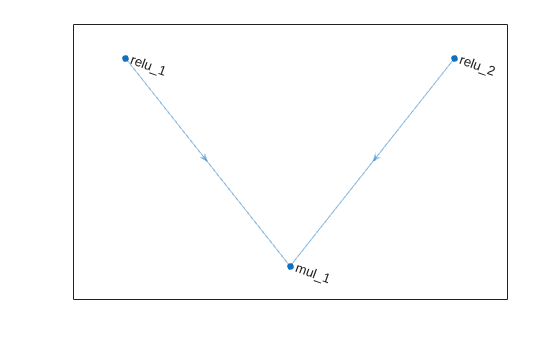
Add them to the network and connect them to the multiplication layer. The multiplication layer multiplies the outputs from the ReLU layers.
net = addLayers(net,relu_1);
net = addLayers(net,relu_2);
net = addLayers(net,mul);

net = connectLayers(net,'relu_1','mul_1/in1');
net = connectLayers(net,'relu_2','mul_1/in2');

plot(net);