Generate Audio Signals
R2026bThis example shows how to generate audio signals on all channels of a multichannel audio device. The example plays Handel's "Hallelujah Chorus" simultaneously on all speakers of a 5.1 surround-sound system.
Load Audio Data
Load Handel's "Hallelujah". The handel MAT-file contains the audio waveform y and the sampling frequency Fs.
load handel;
Plot Audio Signal
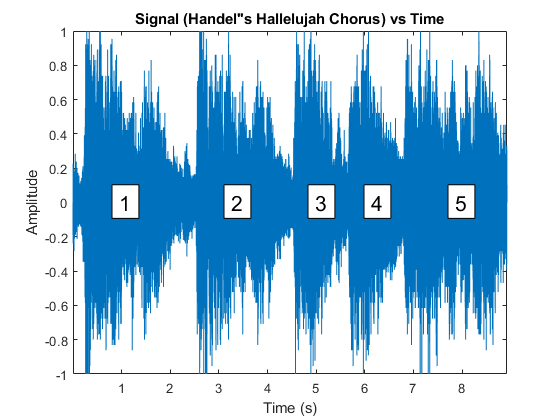
Plot the audio waveform to identify five distinct segments. Each segment represents a "Hallelujah" in the chorus.
t = (0:length(y)-1) / Fs;
fig = figure;
plot(t,y./max(y));
axis tight;
title("Signal (Handel''s Hallelujah Chorus) vs Time");
xlabel("Time (s)");
ylabel("Amplitude");
Annotate the five segments on the plot.
markers = struct("xpos",[0.2, 0.4, 0.55, 0.65, 0.8],"string",num2str((1:5)'));
for i = 1:5
    annotation(fig,"textbox",[markers.xpos(i) 0.48 0.048 0.080], ...
        "String",markers.string(i),"BackgroundColor","w","FontSize",16);
end
Create Data Acquisition Object
Create a DataAcquisition object using directsound as the vendor ID.
dq = daq("directsound");
Add Output Channels
Add six audio output channels using the addoutput function. Replace "Audio2" with the device ID of your multichannel audio device. Adjust numChannels to match the number of output channels available on your device.
deviceID = "Audio2";
numChannels = 6;
addoutput(dq,deviceID,1:numChannels,"Audio");
Set the generation scan rate to match the audio sampling frequency.
dq.Rate = Fs;
Generate Audio on All Channels
Generate the audio signal on all channels simultaneously using the write function. The repmat function replicates the waveform across all channels.
write(dq,repmat(y,1,numChannels));

