Main Content

tdesignLoudspeakerLayout

T-design loudspeaker layout coordinates

Since R2026a

    Description

    LSSph = tdesignLoudspeakerLayout returns the spatial location, in spherical coordinates, of each loudspeaker in an 21-degree default t-design spherical grid.

    example

    LSSph = tdesignLoudspeakerLayout(Name=Value) specifies options using one or more name-value arguments. For example, to specify the t-design polynomial degree, set Degree.

    example

    tdesignLoudspeakerLayout is a convenience syntax that plots a default 21-degree t-design grid.

    example

    tdesignLoudspeakerLayout(Name=Value) is a convenience syntax that plots a t-design grid using the options specified in the name-value arguments.

    example

    Examples

    collapse all

    Decode an ambisonic-encoded signal to a t-design loudspeaker layout and plot the layout.

    Read in an ambisonic-encoded signal.

    [audioIn,fs] = audioread("Heli_16ch_ACN_SN3D.wav");

    Define a t-design loudspeaker layout with a degree of seven.

    loudspeakers = tdesignLoudspeakerLayout(Degree=7);

    Plot the t-design layout grid.

    tdesignLoudspeakerLayout(Degree=7)
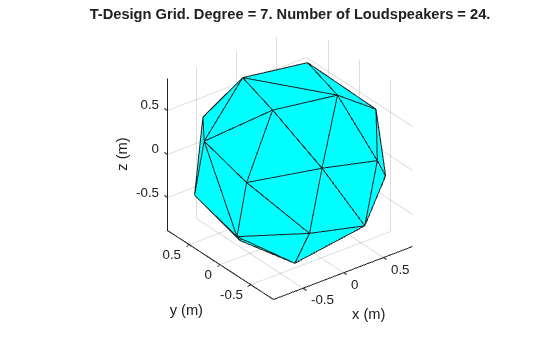
    Figure contains an axes object. The axes object with title T-Design Grid. Degree = 7. Number of Loudspeakers = 24., xlabel x (m), ylabel y (m) contains an object of type patch.

    Design the decoding matrix with an order of three.

    dmtrx = ambisonicDecoderMatrix(3, loudspeakers,...
            Normalization="sn3d",ChannelOrder="acn");

    Decode the signal to the t-design loudspeaker layout.

    audioOut = audioIn*dmtrx;

    Name-Value Arguments

    collapse all

    Specify optional pairs of arguments as Name1=Value1,...,NameN=ValueN, where Name is the argument name and Value is the corresponding value. Name-value arguments must appear after other arguments, but the order of the pairs does not matter.

    Example: Tcoords = tdesignLoudspeakerLayout(Degree=12)

    T-design polynomial degree, specified as an integer in the range [1,21]. A higher degree results in a higher resolution spherical grid that contains more loudspeaker points. The default value of 21 generates 240 loudspeaker locations.

    Data Types: double

    Output data type, specified as "double" or "single". Set this argument to "single" to force all matrix computations to be performed in single precision.

    Data Types: char | string

    Output Arguments

    collapse all

    Spatial location of each loudspeaker in spherical coordinates, returned as an N-by-2 matrix, where N is the number of loudspeakers. The first column corresponds to the azimuth, and the second column corresponds to the elevation. The azimuth values are in the range [0,360], and the elevation values are in the range –[90,90]. Units are in degrees.

    References

    [1] Hardin, R. H. and N. J. A. Sloane. “McLaren’s Improved Snub Cube and Other New Spherical Designs in Three Dimensions.” Discrete and Computational Geometry 15 (1996): 429-441.

    Extended Capabilities

    expand all

    C/C++ Code Generation
    Generate C and C++ code using MATLAB® Coder™.

    Version History

    Introduced in R2026a