You are now following this Submission
- You will see updates in your followed content feed
- You may receive emails, depending on your communication preferences
histnd Histogram count of ND data with ND bins
histmat = histnd(x, y, ..., xedges, yedges, ...)
Extract ND histogram data containing the number of events
of [x, y, ...] tuples that fall in each bin of the ND-grid defined by
xedges, yedges, .... The edges are passed to histc internally and should
therefore conform to histc's input restrictions: the edge-vectors should
be monotonically non-decreasing.
[histmat, nOOF, OOFidx] = histnd(x, y, ..., xedges, yedges, ...)
If any values are outside of the range of the edges, they are not
counted. The number of those cases and their linear index in the input
data is however returned in the second and third output arguments.
EXAMPLES
events = 1000000;
x1 = sqrt(0.05)*randn(events,1)-0.5; x2 = sqrt(0.05)*randn(events,1)+0.5;
y1 = sqrt(0.05)*randn(events,1)+0.5; y2 = sqrt(0.05)*randn(events,1)-0.5;
x= [x1;x2]; y = [y1;y2];
For linearly spaced edges:
xedges = linspace(-1,1,64); yedges = linspace(-1,1,64);
histmat = histnd(x, y, xedges, yedges);
figure; pcolor(xedges,yedges,histmat'); colorbar ; axis square tight ;
For nonlinearly spaced edges:
xedges_ = logspace(0,log10(3),64)-2; yedges_ = linspace(-1,1,64);
histmat_ = histnd(x, y, xedges_, yedges_);
figure; pcolor(xedges_,yedges_,histmat_'); colorbar ; axis square tight ;
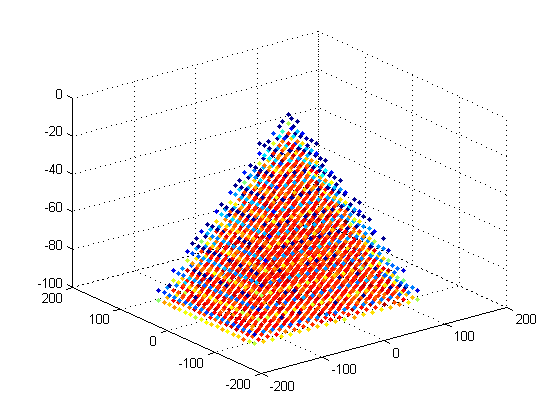
3D data
x = 3.*randn(640000,1);
y = 1.*randn(640000,1);
z = 1.*randn(640000,1);
histmat = histnd(x,y,z,linspace(min(x),max(x),20),linspace(min(y),max(y),20),linspace(min(z),max(z),20));
% make 3D hist, color of points indicates count
[xp,yp,zp] = meshgrid(linspace(min(x),max(x),20),linspace(min(y),max(y),20),linspace(min(z),max(z),20));
% cut away histogram positions where count is 0
qzero = histmat==0;
histmat(qzero) = [];
xp(qzero) = [];
yp(qzero) = [];
zp(qzero) = [];
% draw points
figure;%('Renderer','OpenGL') % might need the openGL renderer to handle so many points
ax = scatter3(xp(:),yp(:),zp(:),'.');
% color them according to count
cdata = histmat(:)./max(histmat);
set(ax,'CData',cdata);
xlabel('X'), ylabel('Y'), zlabel('Z')
Cite As
Diederick (2026). histograms for ND data (https://nl.mathworks.com/matlabcentral/fileexchange/31889-histograms-for-nd-data), MATLAB Central File Exchange. Retrieved .
Acknowledgements
Inspired by: 2D Histogram Calculation
General Information
- Version 1.0.0.0 (2.44 KB)
MATLAB Release Compatibility
- Compatible with any release
Platform Compatibility
- Windows
- macOS
- Linux
| Version | Published | Release Notes | Action |
|---|---|---|---|
| 1.0.0.0 |
