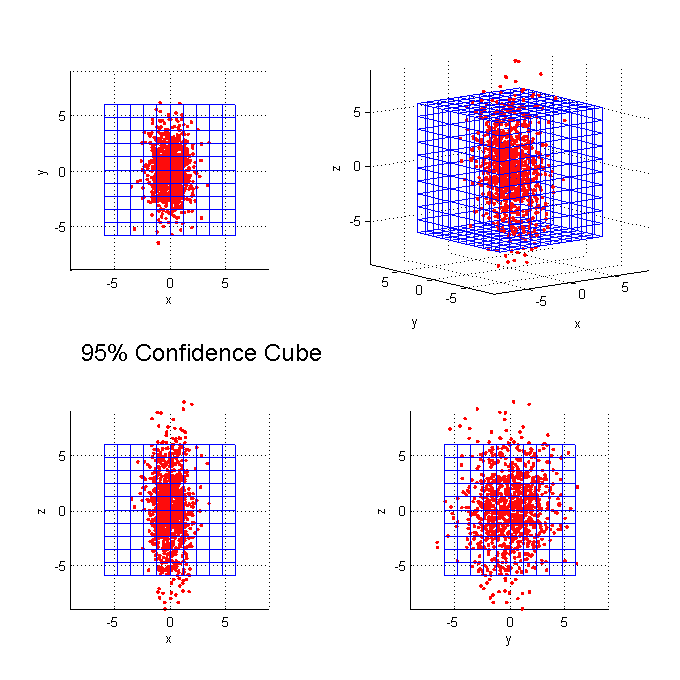
R = RCR(S) computes the semi-edge-length of the mean-centered hypercube with 95% probability given S, which is either a covariance matrix or a vector of standard deviations from a multivariate normal distribution. If S is a real, nonnegative vector, RCR(S) is equivalent to RCR(DIAG(S.^2)). Scalar S is treated as a standard deviation.
R = RCR(S,P) computes the semi-edge-length of the hypercube with probability P instead of the default, which is 0.95. R is the two-tailed, equicoordinate quantile corresponding to P. The hypercube edge-length is 2*R.
R = RCR(S,P,NP) uses NP quadrature points instead of the default, which is 2^11. Smaller values of NP result in faster computation, but may yield less accurate results. Use [] as a placeholder to obtain the default value of P.
R = RCR(S,P,NP,M) performs a bootstrap validation with M normally distributed random samples of size 1e6. Use [] as a placeholder to obtain the default value of NP.
R = RCR(S,P,NP,[M N]) performs a bootstrap validation with M normally distributed random samples of size N.
[R,E] = RCR(S,...) returns an error estimate E.
Cite As
Tom Davis (2026). Rectangular Confidence Regions (https://nl.mathworks.com/matlabcentral/fileexchange/11627-rectangular-confidence-regions), MATLAB Central File Exchange. Retrieved .
MATLAB Release Compatibility
Platform Compatibility
Windows macOS LinuxCategories
Tags
Acknowledgements
Inspired by: Confidence Region Radius
Discover Live Editor
Create scripts with code, output, and formatted text in a single executable document.
| Version | Published | Release Notes | |
|---|---|---|---|
| 1.0.0.0 | updated contact information |
