ccdesign
R2026bCentral composite design
Description
dCC = ccdesign(n)dCC containing a central composite (Box-Wilson) design
for n factors, where n is a positive integer
scalar in the range [2, 26]. The size of dCC is
m-by-n, where m is the number
of runs (points) in the design. Each row of dCC contains the settings
of all factors for that run. The factor values are normalized so that the cube points take
values between –1 and 1.
dCC = ccdesign(n,Name=Value)dCC with additional options specified by one or more name-value
arguments. For example, you can specify the number of center points, and the maximum number
of points per block.
[
additionally returns a 1-by-m vector containing the block numbers for
each run, using any of the input argument combinations in the previous syntaxes. The blocks
indicate the runs to measure under similar conditions in order to minimize the effect of
inter-block differences on the parameter estimates.dCC,blocks] = ccdesign(___)
Examples
Create a two-factor central composite circumscribed design.
dCC = ccdesign(2);
Display the last 10 runs of the design.
disp(dCC(end-9:end,:))
         0   -1.4142
         0    1.4142
         0         0
         0         0
         0         0
         0         0
         0         0
         0         0
         0         0
         0         0
The design contains eight center points to reduce the correlations among the coefficient estimates.
Visualize the design.
plot(dCC(:,1),dCC(:,2),"ro",MarkerFaceColor="b")
X = [1 -1 -1 -1; 1 1 1 -1];
Y = [-1 -1 1 -1; 1 -1 1 1];
line(X,Y,Color="b")
axis square equal
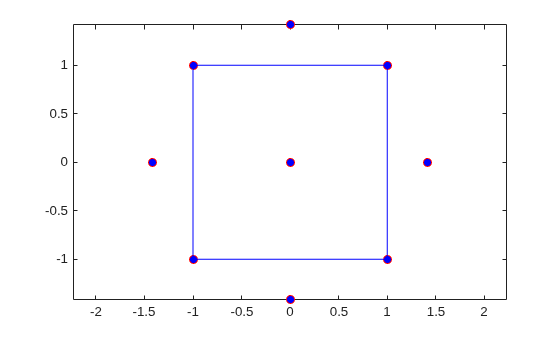
The coordinates of each point represent the factor settings of a run in the design. In the circumscribed design, four points are located outside the main square.
Create a three-factor central composite design with the faced type.
[dCC,blocks] = ccdesign(3,Type="faced")dCC = 24×3
-1 -1 -1
-1 -1 1
-1 1 -1
-1 1 1
1 -1 -1
1 -1 1
1 1 -1
1 1 1
-1 0 0
1 0 0
0 -1 0
0 1 0
0 0 -1
0 0 1
0 0 0
⋮
blocks = 24×1

     1
     1
     1
     1
     1
     1
     1
     1
     2
     2
     2
     2
     2
     2
     1
      ⋮
Visualize the design. Display the runs in the first block with blue points, and the runs in the second block with red points.
plot3(dCC(blocks == 1,1),dCC(blocks==1,2),dCC(blocks==1,3),"bo", ...
         MarkerFaceColor="b")
hold on
plot3(dCC(blocks == 2,1),dCC(blocks==2,2),dCC(blocks==2,3),"ro", ...
         MarkerFaceColor="r")
set(gca,Box="on",BoxStyle="full")
line([0 0],[0,0],[-1 1],Color="r",LineStyle=":")
line([-1 1],[0,0],[0 0],Color="r",LineStyle=":")
line([0 0],[-1,1],[0 0],Color="r",LineStyle=":")
axis square equal
hold off
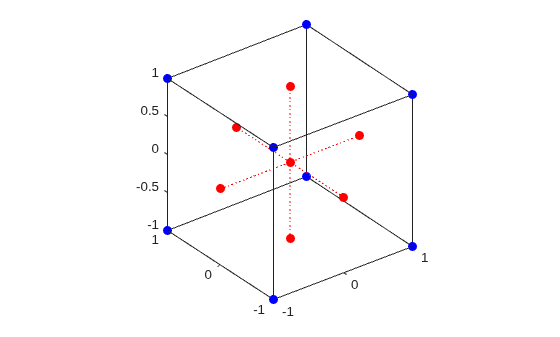
The coordinates of each point represent the factor settings of a run in the design. Because the design has the faced type, each star point is located on a face of the cube.
Input Arguments
Name-Value Arguments
Output Arguments
Alternative Functionality
Instead of using ccdesign, you can create a
responseSurfaceDOE object by using the responseSurfaceDOE
function. The responseSurfaceDOE function provides the following
advantages:
The function allows you to specify design options such as the type of central composite design, factor names, factor level bounds, blocks, and experiment model.
In addition to returning the design runs, the function stores your specifications in the
responseSurfaceDOEobject properties.After you create a
responseSurfaceDOEobject, you can:Fit a linear regression model to the design run responses using the
fitlmfunction.Randomize the run order in the design using the
randomizeRunOrderfunction.Add replicates (duplicates of the original design runs) using the
addReplicatesfunction.
References
[1] Box, G. E. P., and K. B. Wilson. "On the Experimental Attainment of Optimum Conditions." Journal of the Royal Statistical Society: Series B (Methodological) 13, no. 1 (January 1951): 1–38. https://doi.org/10.1111/j.2517-6161.1951.tb00067.x.
[2] Box, G. E. P., W. G. Hunter, and J. S. Hunter. Statistics for Experimenters. Hoboken, NJ: Wiley-Interscience, 1978.
[3] Box, G. E. P., W. G. Hunter, and J. S. Hunter. "Multi-Factor Experimental Designs for Exploring Response Surfaces." Annals of Mathematical Statistics 28, no. 1 (March 1957): 195–241. https://doi.org/10.1214/aoms/1177707047.
Version History
Introduced before R2006a

