Load Images, Spatial Referencing Information, and Initial Transformation
R2026bYou can load images into Registration Estimator from file or from the workspace. You can also provide optional spatial referencing information and an optional initial geometric transformation.
Load Images from File or Workspace
You can load images into Registration Estimator from file or from the
workspace. Although you can load grayscale or color images, the app converts all RGB images
to grayscale by using the rgb2gray function. Registration
Estimator supports only 2-D images.
Loading images from file supports only BMP, JPG, JPEG, TIF, TIFF, PNG, and DCM file
types. To work with a wider range of file formats, load images from the workspace.
Registration Estimator supports any image read into the workspace by the
imread or dicomread function.
Load images into the app by clicking the Load Images icon.
To load images from a file, select the
Load from fileoption. In the dialog box, specify the file path of the moving and fixed images. Use Browse to navigate to a folder.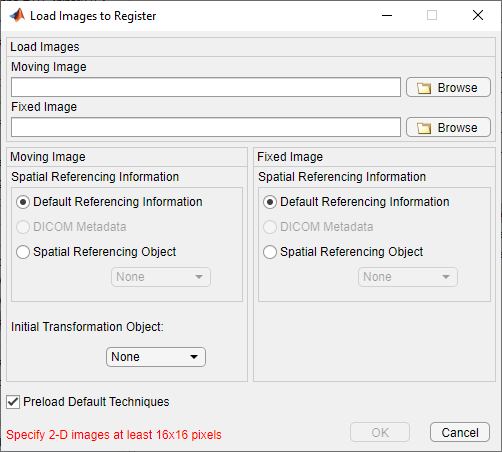
To load variables from the workspace, select the
Load from
                workspace
option. In the dialog box, select the name of the variable containing the moving image from the Moving Image menu and the variable containing the fixed image from the Fixed Image menu.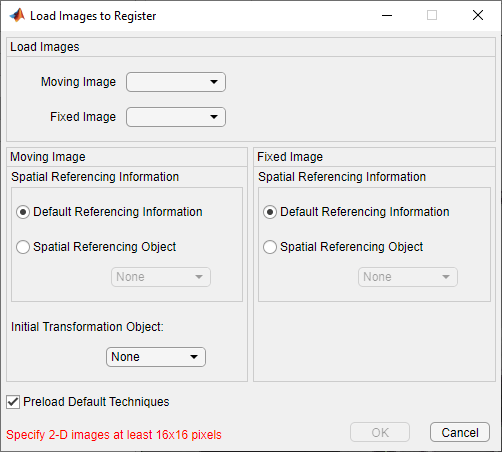
Provide Spatial Referencing Information
If you have 2-D spatial referencing objects in your workspace, or if you load DICOM
images from a file, then you can provide optional spatial referencing information. Spatial
referencing information is useful if you want to orient the images to a world coordinate
system. For more information about spatial referencing objects, see imref2d.
Note
If you load DICOM images into the workspace using the dicomread
function, then spatial referencing information in the metadata is no longer associated
with the image data. To preserve spatial referencing information with DICOM images,
either load the images from file or create an imref2d object from the
image metadata. For more information about DICOM metadata, see Read Metadata from DICOM Files.
If you do not have spatial referencing information, then the Spatial Referencing Object and DICOM Metadata radio buttons are inactive.
Provide an Initial Geometric Transformation
You can provide an optional initial geometric transformation. An initial geometric
transformation is useful when you have an estimate of the geometric distortion between the
images. Specify the geometric transformation as an affinetform2d or
projtform2d
geometric transformation object in your workspace. Registration Estimator applies
the geometric transformation to the moving image (including any spatial referencing
information of the moving image) before performing the registration techniques.
Note
If you have a 2-D geometric transformation object that is not an
affinetform2d or projtform2d object, then convert your
object to an affinetform2d object. For example, suppose you have an
initial similarity transformation in a simtform2d object named
myTform:
newTform = affinetform2d(myTform);
If you do not have a geometric transformation object in your workspace, then the Initial Transformation Object selection box is inactive.
See Also
imread | dicomread | imref2d | affinetform2d | projtform2d

