designDUC
R2026bDescription
H = designDUCdsp.DUC
System object™. The default design uses interpolation factors of [2 2 25], a passband ripple of
0.1 dB, a stopband attenuation of 60 dB, and a bandwidth of 90% of the input Nyquist rate.
H = designDUC(Name=Value)designDUC(InterpolationFactors=[3 512],Bandwidth=0.01,StopbandAttenuation=80)
designs a 2-stage DUC with a compensating FIR interpolation factor of 3 and a CIC
interpolation factor of 512, with 80 dB of stopband attenuation.
Unless you specify the FilterOrders argument, the function uses
minimum order design. Once you specify FilterOrders, the function
uses the specified order design.
Examples
Design a digital upconverter using default specifications. Display the resolved design parameters and visualize the filter response.
Design a 3-stage DUC with default specifications and display the resolved design parameters.
H = designDUC(Verbose=true)
designDUC(InterpolationFactors=[2 2 25], Bandwidth=1.8, PassbandRipple=0.1, StopbandAttenuation=60, InputSampleRate="normalized")
H =
  dsp.DUC with properties:

    NormalizedFrequency: true
             Oscillator: "Sine wave"
        CenterFrequency: 0
                 Filter: [1×1 dsp.FilterCascade]
          MixerDataType: "Same as input"
Visualize the frequency response of the filter cascade.
filterAnalyzer(H.Filter)
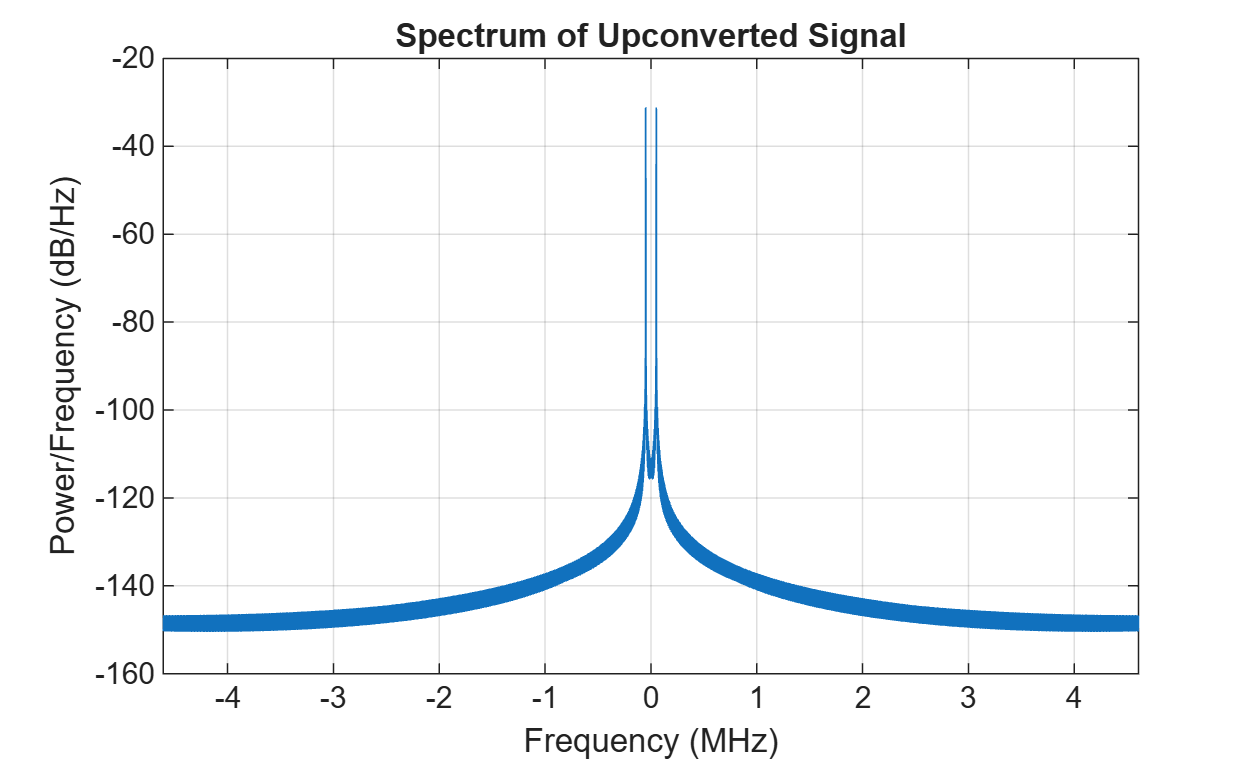
Design a 2-stage dsp.DUC object with custom specifications. Use the resulting object to upconvert a baseband signal to 50 kHz.
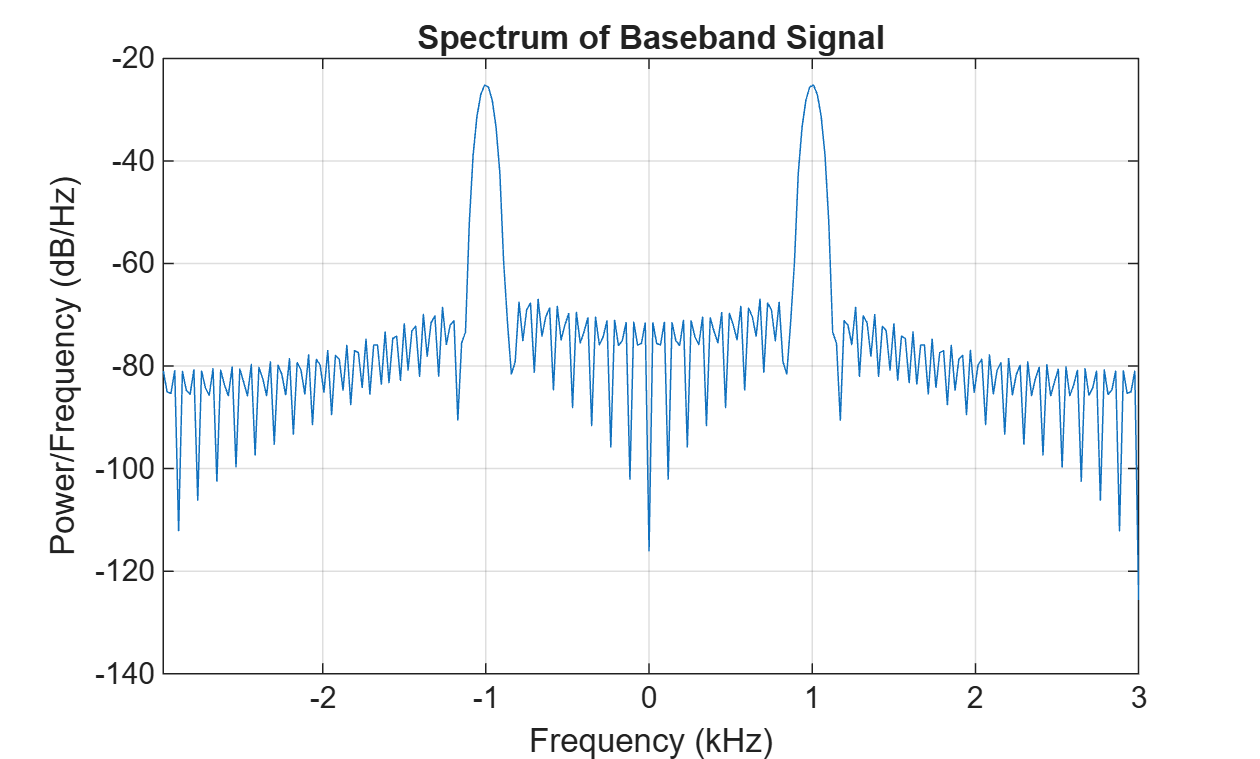
Create a 1 kHz sine wave at a sample rate of 6 kHz.
Fs = 6e3;
sine = dsp.SineWave(Frequency=1000, ...
    SampleRate=Fs, ...
    SamplesPerFrame=1024);
x = sine();
Design a 2-stage DUC with a total interpolation factor of 1536. Set the signal bandwidth to 2 kHz and the stopband attenuation to 55 dB.
L = [3 512];
H = designDUC(InterpolationFactors=L, ...
    InputSampleRate=Fs, ...
    Bandwidth=2e3, ...
    StopbandAttenuation=55, ...
    Verbose=true);
designDUC(InterpolationFactors=[3 512], Bandwidth=2000, PassbandRipple=0.1, StopbandAttenuation=55, InputSampleRate=6000)
H.CenterFrequency = 50e3;
Upconvert the signal. Visualize the spectrum before and after upconversion.
xUp = H(x);
FsOut = Fs*prod(L);
window = hamming(floor(length(x)/10));
figure
pwelch(x,window,[],[],Fs,"centered")
title("Spectrum of Baseband Signal")
window = hamming(floor(length(xUp)/10));
figure
pwelch(xUp,window,[],[],FsOut,"centered")
title("Spectrum of Upconverted Signal")
Design a 3-stage dsp.DUC object at a specific input sample rate and inspect the filter cascade.
Design a 3-stage DUC at 10 kHz with interpolation factors [2 7 631].
L = [2 7 631];
H = designDUC(InterpolationFactors=L, InputSampleRate=10e3, Verbose=true);
designDUC(InterpolationFactors=[2 7 631], Bandwidth=9000, PassbandRipple=0.1, StopbandAttenuation=60, InputSampleRate=10000)
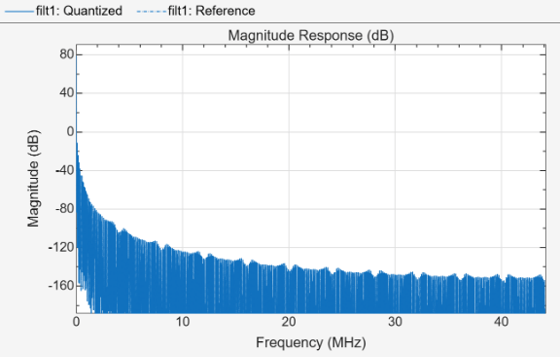
View the filter cascade information and frequency response.
info(H)
ans =
    'Digital Up Converter
     ----------------------------
     Input sample rate                    : 10 kHz
     Oscillator type                      : Sine wave
     Oscillator center frequency          : 0 Hz

     ----------------------------------------------------
     Filter type           : dsp.FilterCascade
     Rate conversion ratio : 8834:1

     Discrete-Time Filter Cascade
     ----------------------------
     Number of stages: 4
     Stage cloning: enabled
     ----------------------------
     Stage1: dsp.FIRInterpolator
     -------
     Discrete-Time FIR Multirate Filter (real)
     -----------------------------------------
     Filter Structure      : Direct-Form FIR Polyphase Interpolator
     Interpolation Factor  : 2
     Polyphase Length      : 38
     Filter Length         : 75
     Stable                : Yes
     Linear Phase          : Yes (Type 1)

     Stage2: dsp.FIRInterpolator
     -------
     Discrete-Time FIR Multirate Filter (real)
     -----------------------------------------
     Filter Structure      : Direct-Form FIR Polyphase Interpolator
     Interpolation Factor  : 7
     Polyphase Length      : 7
     Filter Length         : 43
     Stable                : Yes
     Linear Phase          : Yes (Type 1)

     Stage3: dsp.CICInterpolator
     -------
     Discrete-Time FIR Multirate Filter (real)
     -----------------------------------------
     Filter Structure      : Cascaded Integrator-Comb Interpolator
     Interpolation Factor  : 631
     Differential Delay    : 1
     Number of Sections    : 3
     Stable                : Yes
     Linear Phase          : Yes (Type 1)

     Stage4: double
     -------


     '
filterAnalyzer(H.Filter)
Design a dsp.DUC object by specifying the filter orders for each stage instead of using minimum order design.
Design a 3-stage DUC with an auxiliary FIR order of 20, a compensator FIR order of 30, and a CIC section count of 5.
H = designDUC(InterpolationFactors=[2 7 120], FilterOrders=[20 30 5], Verbose=true);
designDUC(InterpolationFactors=[2 7 120], Bandwidth=1.8, FilterOrders=[20 30 5], InputSampleRate="normalized")
Display the filter cascade information.
info(H)
ans =
    'Digital Up Converter
     ----------------------------
     Input sample rate                    : normalized
     Oscillator type                      : Sine wave
     Oscillator center frequency          : 0 (normalized)

     ----------------------------------------------------
     Filter type           : dsp.FilterCascade
     Rate conversion ratio : 1680:1

     Discrete-Time Filter Cascade
     ----------------------------
     Number of stages: 4
     Stage cloning: enabled
     ----------------------------
     Stage1: dsp.FIRInterpolator
     -------
     Discrete-Time FIR Multirate Filter (real)
     -----------------------------------------
     Filter Structure      : Direct-Form FIR Polyphase Interpolator
     Interpolation Factor  : 2
     Polyphase Length      : 11
     Filter Length         : 21
     Stable                : Yes
     Linear Phase          : Yes (Type 1)

     Stage2: dsp.FIRInterpolator
     -------
     Discrete-Time FIR Multirate Filter (real)
     -----------------------------------------
     Filter Structure      : Direct-Form FIR Polyphase Interpolator
     Interpolation Factor  : 7
     Polyphase Length      : 5
     Filter Length         : 31
     Stable                : Yes
     Linear Phase          : Yes (Type 1)

     Stage3: dsp.CICInterpolator
     -------
     Discrete-Time FIR Multirate Filter (real)
     -----------------------------------------
     Filter Structure      : Cascaded Integrator-Comb Interpolator
     Interpolation Factor  : 120
     Differential Delay    : 1
     Number of Sections    : 5
     Stable                : Yes
     Linear Phase          : Yes (Type 2)

     Stage4: double
     -------


     '
Name-Value Arguments
Output Arguments
Algorithms
The designDUC function designs a multistage interpolation
filter cascade equivalent to a single-stage lowpass FIR filter preceded by a
rate-change element. The cascade consists of:
Auxiliary FIR Interpolator (3-stage only) — Provides additional filtering and interpolation by a factor of 1 or 2.
CIC Compensator FIR Interpolator — Compensates for the CIC passband droop and provides additional interpolation.
CIC Interpolator — Performs the bulk of the interpolation at a low computational cost.
Gain Normalization — A scalar that compensates for the CIC gain.
The following diagram shows the 3-stage filter cascade structure. For a 2-stage design, the auxiliary FIR interpolator is not present.
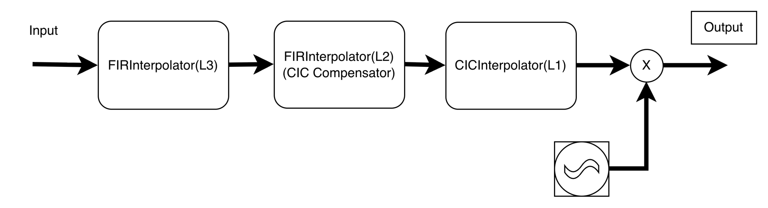
The auxiliary FIR interpolator, present only in 3-stage designs, provides additional
filtering and interpolates by a factor of L3 (1 or 2). The CIC compensator FIR
interpolator corrects the passband droop introduced by the CIC stage and interpolates by
a factor of L2. The CIC interpolator performs the bulk of the rate change with
interpolation factor L1. The elements of the InterpolationFactors
argument correspond to [L2 L1] for a 2-stage design or [L3 L2 L1] for a 3-stage
design.
Version History
Introduced in R2026b

