bandwidth
R2026bSyntax
Description
absBW = bandwidth(___)absBW for the specified antenna or
array at each resonant frequency within the specified frequency range.
[
calculates and returns the absolute bandwidths absBW,fRES,fL,fU,S] = bandwidth(___)absBW at each resonant
frequency in fRES, and the lower (fL) and upper
(fU) bounds for the specified antenna or array.
absBW and fRES are empty if no bandwidth or resonant
frequency is detected within the specified frequency range. absBW and
fRES are vectors when there are more than one bandwidths.
S is a vector of all the S11 values across the
specified frequency range.
[___,
uses the specified frequency sweep interpolation method to calculate the bandwidth of an
antenna or array, and additionally returns the interpolation method type and rational fit
parameters stored in a frequency sweep object sweepobj] = bandwidth(___,SweepOption=Value)sweepobj.
[___] = bandwidth(___,
specifies additional options using one or more name-value
arguments. For example,
Name=Value)bandwidth(dipole,60e6:1e6:80e6,Threshold=-10) marks the bandwidth on
the S11 plot of the dipole antenna in the 60 MHz to 80 MHz range with
an S11 threshold of -10 dB.
Examples
This example shows how to calculate and plot the bandwidth of a dipole antenna for different thresholds.
Create Dipole, Calculate and Plot Bandwidth with Default Threshold
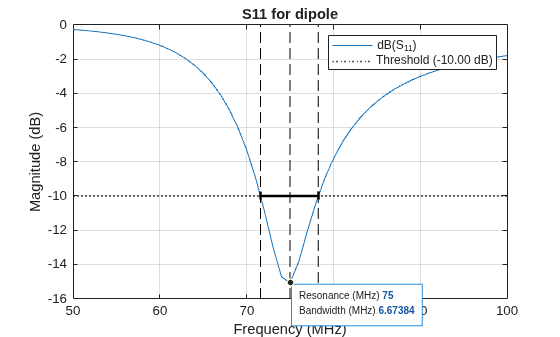
Create a dipole operating at 75MHz. Calculate and plot the bandwidth of a dipole for a default threshold of -10dB over a frequency span 50MHz to 100MHz.
h = design(dipole,75e6);
absBW = bandwidth(h,50e6:1e6:100e6)
absBW =
6.6738e+06
bandwidth(h,50e6:1e6:100e6);
Calculate and Plot Bandwidth with Custom Threshold
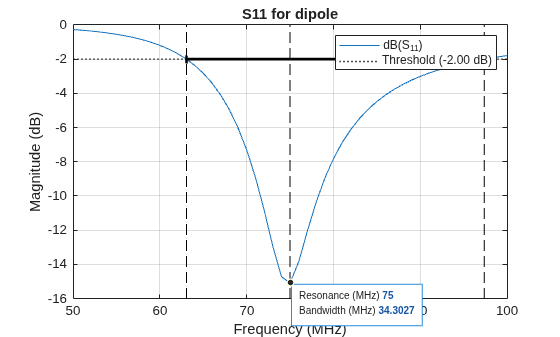
Calculate and plot the bandwidth of the same dipole, using a -2dB threshold, over the same frequency span.
absBW = bandwidth(h,50e6:1e6:100e6,Threshold=-2)
absBW =
3.4303e+07
bandwidth(h,50e6:1e6:100e6,Threshold=-2);
Input Arguments
Name-Value Arguments
Output Arguments
Tips
Interpolating frequency sweeps may report results at frequencies that differ from the frequencies you specify. If you require results at exact frequencies, either use the default direct sweep, or set the
NumFreqsproperty of thefrequencySweepobject greater than or equal to the number of frequencies you provide.When using the
"interp"or"interpWithGrad"sweep options, provide more than 30 frequency points to have the sweep use your frequency resolution exactly; otherwise the sweep defaults to 100 points across the band.

