mhsample
R2026bGenerate Markov chain sample using Metropolis–Hastings sampler
Description
sample = mhsample(start,numsamples,Name=Value)numsamples random draws from the
target stationary distribution by using the Metropolis–Hastings sampler, a Markov chain
Monte Carlo (MCMC) algorithm. mhsample initializes the sampler from
start, and then draws samples using the proposal random number
generator.
You must specify these inputs using name-value arguments:
Target PDF Form — Specify the target stationary distribution or its log by using
PDForLogPDF, respectively.Proposal Random Number Generator — Specify a supported distribution name or function by using
ProposalorPropRND, respectively.Proposal Distribution Description — When you use
Proposal, specify the proposal scale usingScale. When you usePropRND, specify one of the following:Symmetricto indicate whether the proposal distribution is symmetricPropPDFto specify the proposal probability distribution function (pdf)LogPropPDFto specify the log of the proposal pdf
You can specify additional options by setting more name-value arguments. For example,
BurnIn=100,Thin=4 removes the first 100 draws from the raw generated
Markov chain (burn-in period of 100), retains every fourth draw of the remaining chain
(thinning factor of 4), and then returns the resulting processed chain in
sample.
For details on which Metropolis–Hastings sampler algorithm
mhsample implements, see Algorithms.
[
also returns the acceptance rate sample,acceptance] = mhsample(___)acceptance of proposal draws for each
Markov chain. When computing acceptance,
mhsample includes any samples omitted for the specified thinning
factor and burn-in period.
Examples
Consider sampling from the Gamma(2.43,1) distribution, and then estimating its second moment.
Create a function that computes the pdf of the Gamma(2.43,1) distribution for an input value.
alpha = 2.43;
beta = 1;
targetPDF = @(x)gampdf(x,alpha,beta);
Although this example uses the exact pdf, typically the target pdf is known only up to a proportionality constant.
Draw 5000 samples (a length 5000 Markov chain) from the Gamma(2.43,1) distribution using the Random-Walk Metropolis–Hastings sampler with a Gaussian proposal and standard deviation of 10. Initialize the sampler from a random positive value in (0,1).
rng(1,"twister")  % For reproducibility
numsamples = 5000;
start = rand(1);
sample = mhsample(start,numsamples,PDF=targetPDF,Proposal="gaussian", ...
    Scale=10);
Create a time series plot of the Markov chain.
figure
plot(sample)
title("Random-Walk Metropolis-Hastings Sample from Gamma(2.43,1)")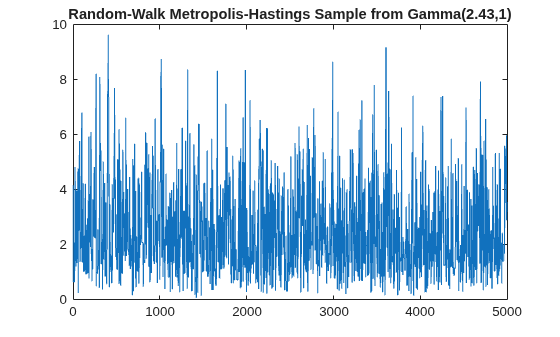
The plot shows little transient behavior and almost no serial correlation, indicating that the Markov chain mixes well.
Fit a Gamma distribution to the sample.
fitdist(sample,"gamma")ans =
GammaDistribution
Gamma distribution
a = 2.65537 [2.55891, 2.75547]
b = 0.921943 [0.885152, 0.960264]
The parameter estimates are close to the true values.
Visually assess the fit.
histfit(sample,15,"gamma")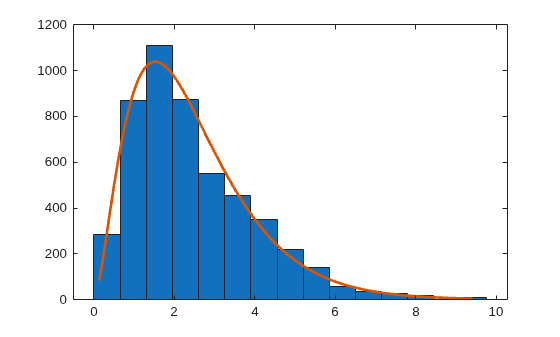
Estimate the second moment of a Gamma distribution by using the sample to perform numerical integration. Compare the result to the theoretical second moment.
x2hat = sum(sample.^2)/numsamples
x2hat =
8.2449
truex2 = beta^2*gamma(alpha+2)/gamma(alpha)
truex2 =
8.3349
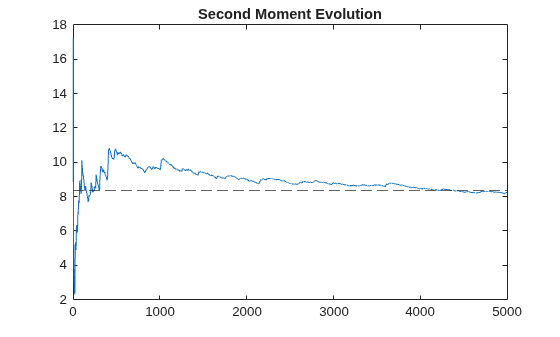
The estimate is close to the theoretical value.
Explore the convergence rate of the estimate by plotting its evolution.
figure
x2hatchain = cumsum(sample.^2)./(1:numsamples)';
plot(x2hatchain)
hold on
yline(truex2,"--")
title("Second Moment Evolution")
Consider sampling from the Gamma(2.43,1) distribution, and then estimating its second moment. This example uses a custom proposal and the Independent Metropolis–Hastings sampler algorithm. In this case, you must use the default value of Symmetric (false) and specify the proposal distribution pdf (either PropPDF or LogPropPDF).
Create a function that computes the pdf of the Gamma(2.43,1) distribution for an input value.
alpha = 2.43;
beta = 1;
targetPDF = @(x)gampdf(x,alpha,beta);
Although this example uses the exact pdf, typically the target pdf is known only up to a proportionality constant.
The sum of exponential random variables with rate has a gamma distribution with shape and scale .
Create a function that accepts the current state of the chain xt, draws random values from an exponential distribution with rate , and then sums the results. This function is the proposal random number generator.
n = floor(alpha);
propRND = @(xt)sum(exprnd(1/beta,n,1));
Create a function that accepts the proposal draw y and current state of the chain xt, and computes the pdf of the proposed draw, which is Gamma(,). The proposal pdf is independent of the current state of the Markov chain, which is indicative of the Independent Metropolis–Hastings sampler, but mhsample requires the current state as an input. Indicate the input current state using ~.
propPDF = @(y,~)gampdf(y,n,beta);
Draw 5000 samples (a length 5000 Markov chain) from the Gamma(2.43,1) distribution using the Independent Metropolis–Hastings sampler with the proposal random number generator and pdf. Initialize the sampler from a random positive value in (0,1).
rng(1,"twister")  % For reproducibility
numsamples = 5000;
start = rand(1);
sample = mhsample(start,numsamples,PDF=targetPDF,PropRND=propRND, ...
    PropPDF=propPDF);
Create a time series plot of the Markov chain.
figure
plot(sample)
title("Independent Metropolis-Hastings Sample from Gamma(2.43,1)")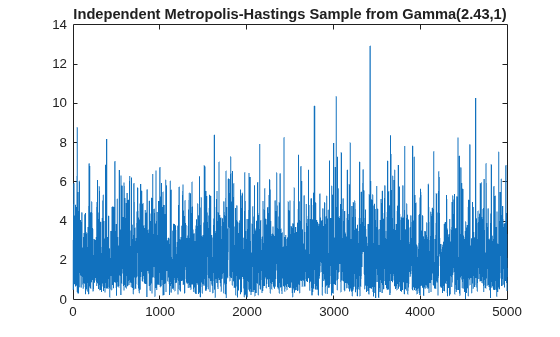
The plot shows little transient behavior and almost no serial correlation, indicating that the Markov chain mixes well.
Fit a Gamma distribution to the sample.
fitdist(sample,"gamma")ans =
GammaDistribution
Gamma distribution
a = 2.44858 [2.36001, 2.54047]
b = 0.996224 [0.95632, 1.03779]
The parameter estimates are close to the true values.
Visually assess the fit.
histfit(sample,15,"gamma")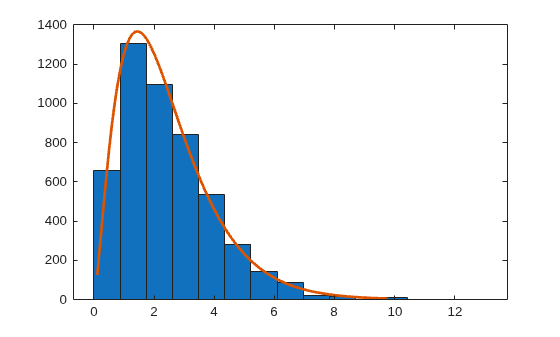
Estimate the second moment of a Gamma distribution by using the sample to perform numerical integration. Compare the result to the theoretical second moment.
x2hat = sum(sample.^2)/numsamples
x2hat =
8.3104
truex2 = beta^2*gamma(alpha+2)/gamma(alpha)
truex2 =
8.3349
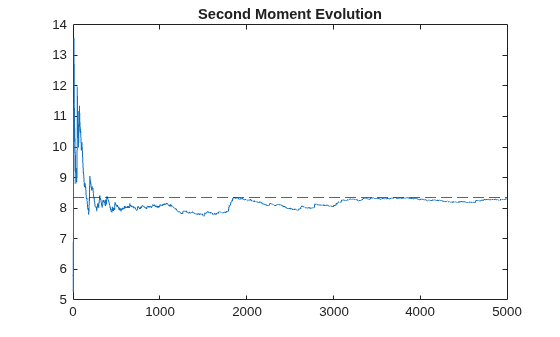
The estimate is close to the theoretical value.
Explore the convergence rate of the estimate by plotting its evolution.
figure
x2hatchain = cumsum(sample.^2)./(1:numsamples)';
plot(x2hatchain)
hold on
yline(truex2,'--')
title("Second Moment Evolution")
Return the acceptance rates for multiple Markov chains.
Create a function that computes the pdf of the Gamma(2.43,1) distribution for an input value.
alpha = 2.43;
beta = 1;
targetPDF = @(x)gampdf(x,alpha,beta);
When you plan to generate multiple chains, ensure that all the custom functions you write and pass to mhsample return a column vector or matrix of values, with each row corresponding to values required by an individual chain. This example uses a univariate, known distribution from which to sample, which simplifies the problem. However, regardless of your functions, you can verify the output by entering test values into each function.
Ensure that the target pdf returns the correct number of pdf evaluations in the correct form.
numchains = 10;
rng(1,"twister")  % For reproducibility
testvalues = gamrnd(alpha,beta,numchains,1);
gold = gampdf(testvalues,alpha,beta);
testtargetpdf = targetPDF(testvalues);
size(testtargetpdf)
ans = 1×2

    10     1
(gold - testtargetpdf)'*(gold - testtargetpdf)
ans =
0
The true and target pdfs show no difference.
Generate 10 Markov chains of size 5000 samples from the Gamma(2.43,1) distribution using the Random-Walk Metropolis–Hastings sampler with a Gaussian proposal and standard deviation of 10. For each Markov chain, initialize the sampler from a random positive value in (0,1). Return the acceptance rate for each chain.
numsamples = 5000;
start = rand(numchains,1);
[sample,acceptance] = mhsample(start,numsamples,PDF=targetPDF,Proposal="gaussian", ...
    Scale=10,NumChains=numchains);
sample is a 5000-by-10 matrix of samples from the target pdf. Each row is an independent sample. acceptance is a column vector of acceptance rates for each sample.
Create a time series plot of each Markov chain.
figure
h = tiledlayout(4,3);
for j = 1:numchains
    nexttile
    plot(sample(:,:,j))
end
title(h,"Sampled Markov Chains")
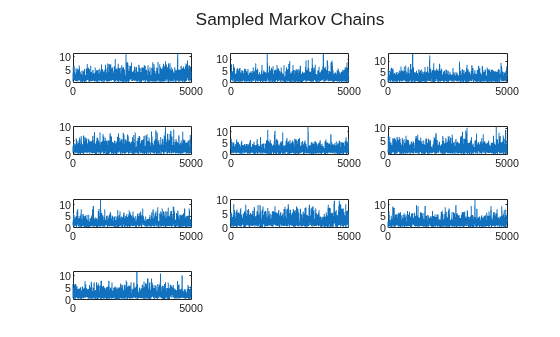
The plots show little transient behavior and almost no serial correlation, indicating that the Markov chains mix well.
Plot the acceptance rates.
figure
plot(acceptance)
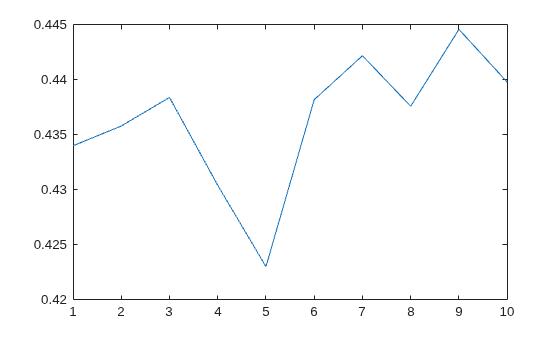
The acceptance rate series is stable, the values are adequate for a Metropolis–Hastings sampler.
Input Arguments
Name-Value Arguments
Output Arguments
More About
Tips
When you plan to return multiple independent samples by using the
NumChainsname-value argument, ensure that all custom functions you pass tomhsamplereturn a numeric column vector or matrix of values, with each row corresponding to the values required by the corresponding Markov chain. The noncustom proposal distributions, available with theProposalname-value argument, enable you to avoid writing custom functions which might not return values in the correct form for multiple Markov chains. The noncustom proposal distributions are easy to use, provide increased sampling speed compared to custom proposals, can be tuned easily, and work well for a variety of applications. Therefore, a good practice is to try settingProposalbefore writing and setting custom proposal distributions.An acceptance rate close to 0 indicates that most proposal draws likely correspond to regions of low probability in the target distribution. An acceptance rate close to 1 can indicate that the proposal draws do not sufficiently explore the target distribution. However, an ideal acceptance rate depends on the target distribution. In general, Gelman, et al, suggest tuning the sampler until the acceptance rate is close to 0.25[1].
Algorithms
mhsample implements the Random-Walk or Independent
Metropolis–Hastings sampler algorithm depending on your specifications.
| Algorithm | Specifications |
|---|---|
| Random-Walk Metropolis–Hastings |
|
| Independent Metropolis–Hastings |
When using the custom proposal functions |
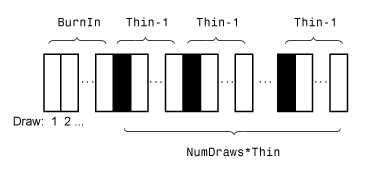
For each of NumChains generated Markov chains,
mhsample draws BurnIn +
Thin*numsamples samples, and
then processes each sample by removing the burn-in draws specified by
BurnIn, and then reducing the remaining draws as specified by the
thinning factor Thin.
This figure illustrates how mhsample reduces the raw MCMC sample.
Rectangles represent successive draws from the distribution. mhsample
removes the white rectangles from the Monte Carlo sample. The remaining
numsamples black rectangles compose sample.
References
[1] Gelman, Andrew, Walter R. Gilks, and Gareth O. Roberts. "Weak Convergence and Optimal Scaling of Random Walk Metropolis Algorithms." The Annals of Applied Probability. 7 (February 1997): 110–120. https://doi.org/10.1214/aoap/1034625254.

