Main Content

Power Sensor (Three-Phase)

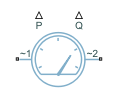
Three-phase ideal active and reactive power sensor
Libraries:
Simscape / Electrical / Sensors & Transducers

Description

The Power Sensor (Three-Phase) block implements an ideal sensor for active and reactive power measurement in balanced or unbalanced three-phase branches.

For balanced branches, the block returns the correct value of the active and reactive power at all time instants. This is the preferred option for a load-flow analysis.

For unbalanced branches, the block independently measures the phasors of the three-phase voltages and currents by using a one-moving-period Fourier transform. The block then calculates the symmetrical set of positive-sequence, negative-sequence, and zero-sequence voltage and current phasors, and returns the value of the active and reactive power as the sum of their positive-sequence, negative-sequence, and zero-sequence components, respectively. (since R2026a)

For more information about how the block calculates the total active and reactive power, see the Equations section of Power Measurement (Three-Phase).

Load-Flow Analysis

If the block is in a network that is compatible with the frequency-time simulation mode, you can perform a load-flow analysis on the network. A load-flow analysis provides steady-state values that you can use to initialize a machine.

For more information, see Perform a Load-Flow Analysis Using Simscape Electrical and Frequency and Time Simulation Mode.

Ports

Conserving

expand all

Electrical conserving port representing the three phases of side 1. For more information, see Three-Phase Ports.

Dependencies

To enable this port, set the Electrical connection parameter to Composite three-phase ports.

Electrical conserving port representing the three phases of side 2. For more information, see Three-Phase Ports.

Dependencies

To enable this port, set the Electrical connection parameter to Composite three-phase ports.

Electrical conserving port associated with the phase a of side 1.

Dependencies

To enable this port, set the Electrical connection parameter to Expanded three-phase ports.

Electrical conserving port associated with the phase b of side 1.

Dependencies

To enable this port, set the Electrical connection parameter to Expanded three-phase ports.

Electrical conserving port associated with the phase c of side 1.

Dependencies

To enable this port, set the Electrical connection parameter to Expanded three-phase ports.

Electrical conserving port associated with the phase a of side 2.

Dependencies

To enable this port, set the Electrical connection parameter to Expanded three-phase ports.

Electrical conserving port associated with the phase b of side 2.

Dependencies

To enable this port, set the Electrical connection parameter to Expanded three-phase ports.

Electrical conserving port associated with the phase c of side 2.

Dependencies

To enable this port, set the Electrical connection parameter to Expanded three-phase ports.

Output

expand all

Physical signal port associated with the active power measurements.

Physical signal port associated with the reactive power measurements.

Parameters

expand all

Since R2026a

Whether to model composite or expanded three-phase ports.

Composite three-phase ports represent three individual electrical conserving ports with a single block port. You can use composite three-phase ports to build models that correspond to single-line diagrams of three-phase electrical systems.

Expanded three-phase ports represent the individual phases of a three-phase system using three separate electrical conserving ports.

Programmatic Use

To set the block parameter value programmatically, use the set_param function.

Parameter: port_option
Values: "ee.enum.threePhasePort.composite" (default) | "ee.enum.threePhasePort.expanded"

Type of load. Select Balanced if the three-phase branches are balanced, Unbalanced if the branches are not balanced.

Rated frequency.

Dependencies

To enable this parameter, set Load Type to Unbalanced.

References

[1] Willems, Jacques, "The IEEE standard 1459: What and why?", 2010 IEEE International Conference on Applied Measurements for Power Systems, Proceedings: 41-46.

Extended Capabilities

expand all

C/C++ Code Generation
Generate C and C++ code using Simulink® Coder™.

Version History

Introduced in R2020b

expand all